
01
Settled / Connected
Present, flexible, able to think and connect.
WORKBOOK BUNDLE $37 $97 · 14-DAY MONEY-BACK GUARANTEE
The Soma Atlas Method
A practical, six-step approach to noticing what is happening and choosing a small, safe experiment that fits.
The Soma Atlas Method
Step 1 · What am I noticing?
Pause and notice your body, energy and attention. Are you tense, restless, heavy, foggy or feeling connected? You do not need to change anything yet.
Use those signals to describe your current state: settled, revved, low or mixed. This is a personal check-in, not a diagnosis.
Ask what you need: less activation, more energy, or more orientation and support. Choose one small tool that fits, rather than an exercise at random.
Try a brief, comfortable version of the tool, such as noticing your feet on the floor or looking at one steady object. Stop if discomfort increases.
Pause again and compare how you feel with your starting point. Notice whether anything feels easier, unchanged or less comfortable; do not force a result.
Write down your starting signals, the tool you tried and what changed. Over time, use your notes to build a personal menu of what tends to help.
The goal is not to diagnose yourself or remain calm all the time. The goal is to become better at noticing patterns, choosing a small experiment, observing your response, and learning what tends to work for you.
The Problem Isn't a Lack of Tools
The difficult part is not always finding another regulation technique.
It is knowing what to try when you feel revved, flat, disconnected, overwhelmed, wired but tired, or simply unsure.
The tool may not be the problem.
The match may be the problem.
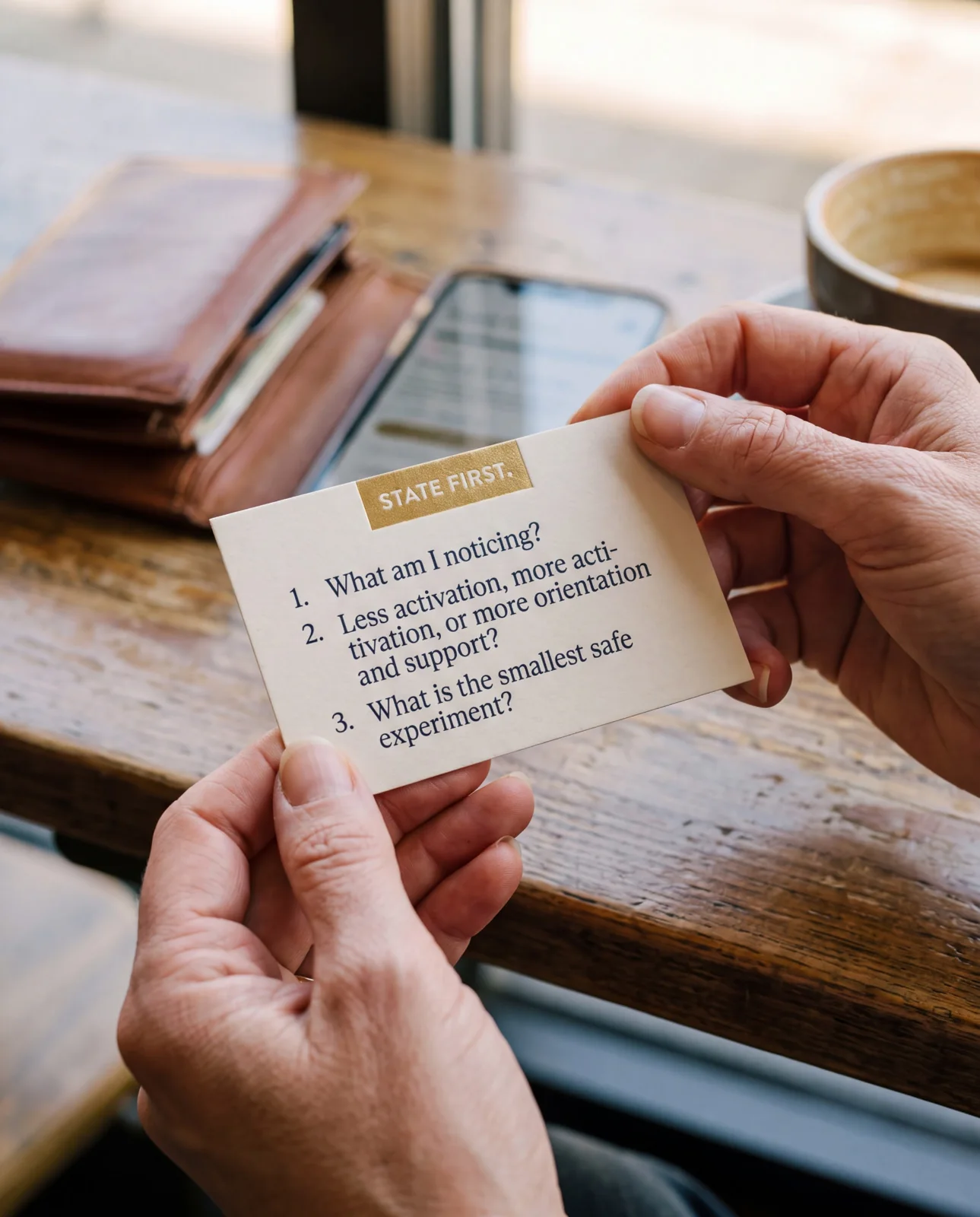
State First.
The 3 Questions
What am I noticing?
Do I need less activation, more activation, or more orientation and support?
What is the smallest safe experiment?
Try Re-check Record
The Working State Map
01
Present, flexible, able to think and connect.
02
Fast, tense, alert, restless or urgent.
03
Heavy, foggy, numb, distant or difficult to initiate.
04
Wired but tired, calm outside and racing inside, or noticing signals that do not fit one simple category.
These are working labels for self-observation, not diagnoses or physiological measurements.
When You Don't Want to Think
Step 0 · Subtract First
Can you turn something down, eat, drink, adjust the environment or step away?
Step 1
What are you noticing?
Aim
Reduce unnecessary intensity
Aim
Gentle manageable mobilization
Aim
Smallest step
Aim
Build capacity for later

Try Re-check Record
This is a decision aid, not medical triage.
The 7-Day Personal Experiment
The goal is not to stay regulated for seven days. The goal is to collect useful information about what tends to help, what does not, and what you want to test next.
Notice what is happening.
Choose a small experiment.
Learn what works for you.
State First. Technique Second.